
Chief Executive
Ministry of Health - NSW Ambulance

CANDIDATE INFORMATION PACK
Scroll down to access everything you need.

Executive Summary
- Lead one of the largest ambulance services globally, with system-wide accountability for emergency and pre-hospital care across New South Wales, influencing health outcomes for more than eight million people.
- Shape the future of a critical public service at a time of rising demand and complexity, driving performance, sustainability and integration across the broader health system.
- Operate at the highest levels of government and health leadership, with significant public visibility and the opportunity to make a lasting impact on community safety and care delivery, based in Sydney at the heart of a dynamic and evolving sector.
THE OPPORTUNITY
NSW Ambulance is a critical component of the NSW public health system, delivering emergency and non-emergency care, patient retrieval services, and major event and disaster response across a population exceeding eight million people. Employing approximately 6,000 staff and supported by a large volunteer workforce across more than 300 locations, the organisation operates a substantial fleet and manages an annual budget exceeding $1 billion, positioning it as one of the largest ambulance services in the world. Within the broader Ministry of Health, NSW Ambulance functions under a defined legislative framework and plays a central role in achieving statewide health priorities, with a strong focus on patient-centred and staff-focused care.
This appointment comes at a time of sustained demand growth, increasing system complexity and heightened expectations regarding responsiveness, safety and performance. The Chief Executive will lead the organisation through these pressures while advancing strategic and clinical service planning, workforce sustainability and financial stewardship. The role is fundamental to ensuring NSW Ambulance continues to meet its statutory obligations, deliver agreed services within budget and contribute effectively to the performance of the broader health system. This includes strengthening integration with Local Health Districts and statewide clinical networks.
THE ROLE
The Chief Executive provides strategic leadership, direction and overall management of NSW Ambulance, with full accountability for organisational performance, governance and the delivery of safe, high-quality care. Reporting to the Secretary, NSW Health, the role oversees the development and implementation of strategic, clinical and operational plans, ensuring services are delivered equitably and aligned to community need. The Chief Executive leads the negotiation and execution of the Service Agreement with government, monitors performance against agreed measures and ensures transparent, accurate reporting across financial, workforce and service domains.
The role carries responsibility for establishing and maintaining robust clinical and corporate governance frameworks, ensuring compliance with legislative and regulatory obligations and alignment with National Safety and Quality Health Service Standards as they apply to ambulance services. As Chief Paramedic Officer, the incumbent provides expert advice to government on the paramedicine profession and contributes to policy and system development. The Chief Executive directs the organisation’s workforce, financial and business planning, maintaining a strong focus on operational efficiency, long-term sustainability and the effective allocation of resources to meet community needs.
Operating in a highly visible and scrutinised environment, the Chief Executive engages extensively across government, the Ministry of Health, Local Health Districts, clinicians, advisory bodies and external stakeholders. The role also represents NSW at national and international levels and contributes to emergency management governance at the highest levels of the State. Internally, the Chief Executive leads a large, geographically dispersed workforce and ensures organisational capability, culture and performance are aligned to strategic objectives and public sector values.
THE CANDIDATE
The successful candidate will have a strong record of leadership in complex, service delivery environments, ideally within the public health system or similarly large-scale, distributed organisations. They will bring demonstrated experience in driving organisational performance, managing significant financial and workforce responsibilities, and operating effectively within the constraints of government policy, funding and regulation. A deep understanding of health service delivery, governance and system integration will be essential, alongside the ability to navigate competing priorities while maintaining a clear focus on patient outcomes and organisational sustainability.
The role requires an authentic and credible leader who can engage effectively with clinicians, executives, government stakeholders and Boards, fostering collaboration and alignment across the system. The successful candidate will demonstrate sound judgement, resilience and the ability to lead through complexity, scrutiny and change, supported by highly developed communication and influencing skills. Personal attributes will include integrity, accountability and a commitment to public value, with the capacity to build a culture of high performance, openness and continuous improvement. This is a significant and rewarding opportunity to lead a critical public service at scale and to make a lasting impact on community health outcomes across New South Wales.
We invite you to discuss this exceptional leadership opportunity with:
Paul Ingle
Chief Executive Officer
M. +61 (0)402 796 125
E. pingle@hardygroupintl.com
Pete Carter
Principal Search Consultant
M. +61 (0)448 729 077 | M. +64 (0)27 287 5937
E. pcarter@hardygroupintl.com
Ministry of Health
NSW Ambulance
Agency Overview
NSW Ambulance operates a mobile health service for the community of NSW providing emergency and non-emergency health care, retrieval and specialist transport services; major event planning and response; and community education. It is one of the largest Ambulance services in the world servicing a population in excess of 8 million, employing approximately 6000 people and about 350 volunteers at more than 300 locations across NSW, operating a fleet of more than 1500 Ambulance and other vehicles, with an annual expenditure budget in excess of $1.5 billion.
NSW Ambulance is a division of the NSW Ministry of Health. The Health Services Act (1997) and Part 4 of the Health Services Regulation (2013) is the legislative framework under which NSW Ambulance functions. The organisation is managed from State Headquarters located at Sydney Olympic Park.
The vision of NSW Ambulance is "excellence in care". NSW Ambulance recognises that quality of service, equity, meeting community needs, investing in our people and organisational performance will be the basis for the development of NSW Ambulance’s future. These concepts are represented in the principle of “Patient Centred and Staff Focused” and are underpinned by NSW Health’s core values of Collaboration, Openness, Respect and Empowerment. Key objectives of the organisation are contained within the NSW Ambulance Strategic Plan.
Our Purpose
NSW Ambulance is an integral part of the NSW Health System delivering mobile health services and providing high-quality clinical care, rescue and retrieval services to those people of NSW with emergency and medical health needs.
Our Vision
Excellence in care.
Our Values
Values-based leadership is vital to a productive and inclusive workplace. Our people are at the heart of everything we do and plan to achieve through to 2026.
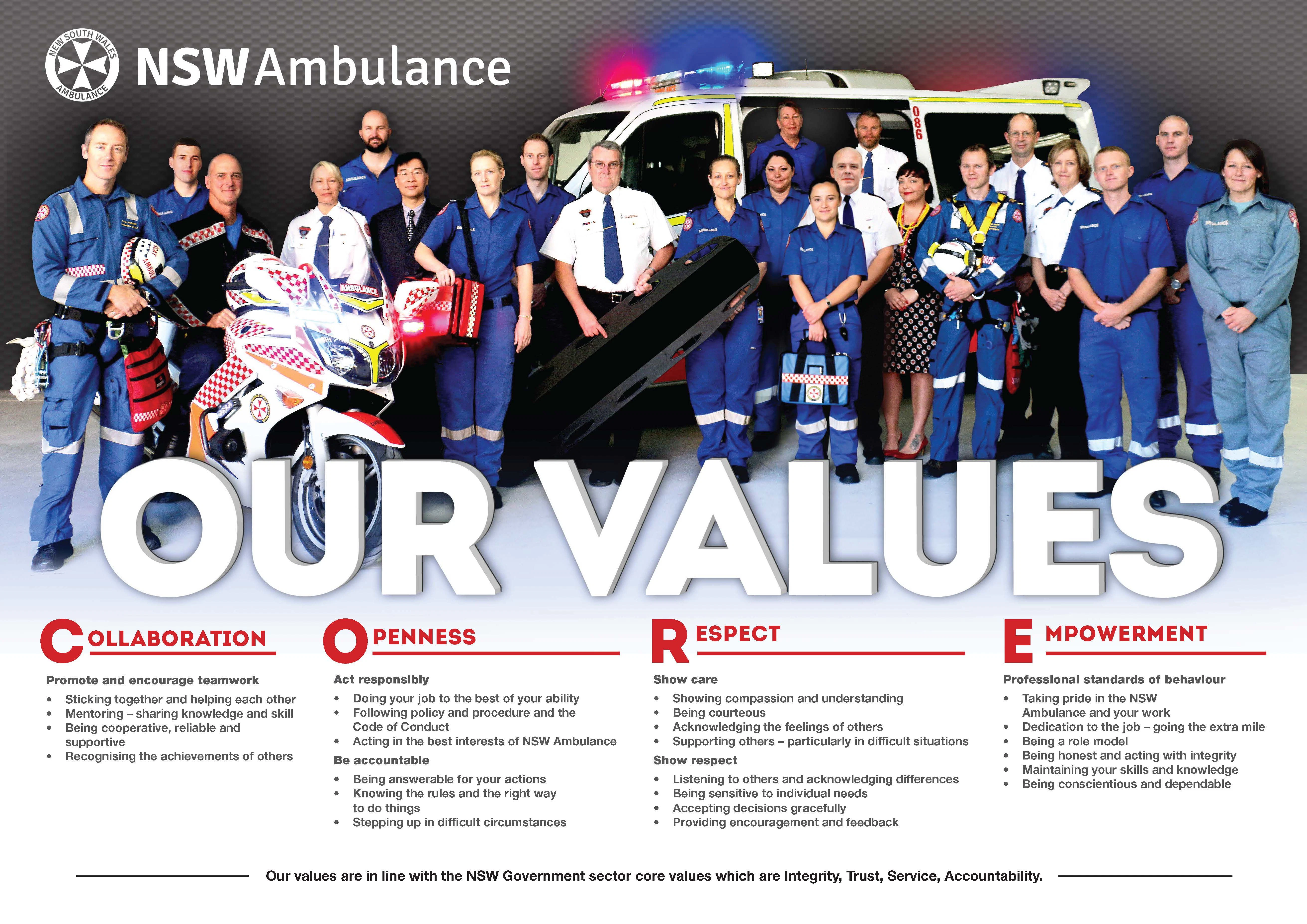
Collaboration
We are committed to working collaboratively with each other to achieve the best possible outcomes for our patients who are at the centre of everything we do. In working collaboratively, we acknowledge that every person working in the health system plays a valuable role that contributes to achieving the best possible outcomes.
Openness
A commitment to openness in our communications builds confidence and greater cooperation. We are committed to encouraging our patients, and all people who work in the health system, to provide feedback that will help us provide better services.
Respect
We have respect for the abilities, knowledge, skills and achievements of all people who work in the health system. We are also committed to providing health services that acknowledge and respect the feelings, wishes and rights of our patients and their carers.
Empowerment
In providing quality healthcare services, we aim to ensure our patients are able to make well informed and confident decisions about their care and treatment. We further aim to create a sense of empowerment in the workplace for people to use their knowledge, skills and experience to provide the best possible care to patients, their families and their carers.
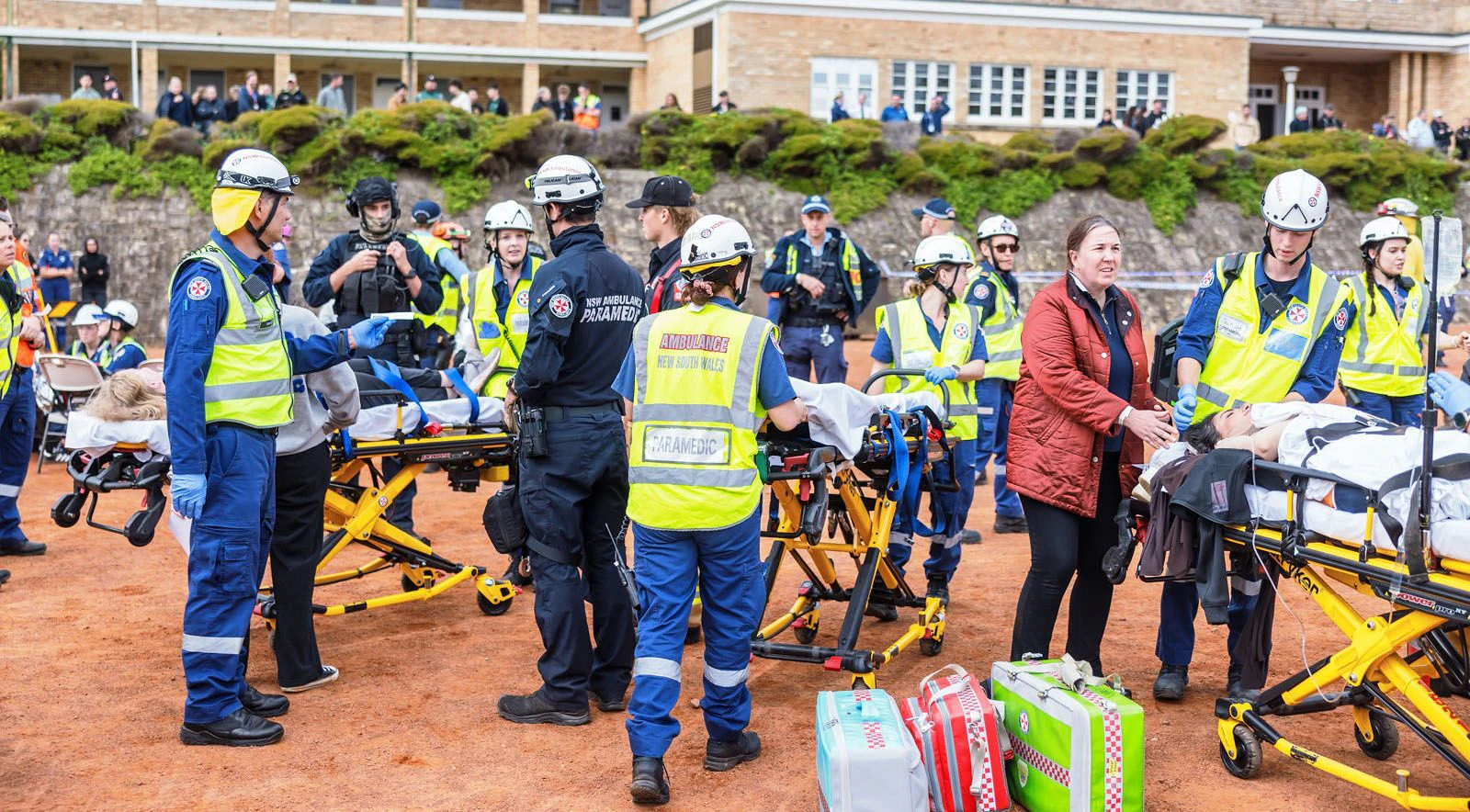
Multi‑agency exercise led by NSW Ambulance strengthens major incident readiness
Credit: Simon Whittaker Photography
Role Specification
The Chief Executive (CE) provides pivotal and strategic leadership, direction and management of NSW Ambulance (NSWA), and is responsible for the sound governance to ensure that NSWA fulfils its statutory operating and reporting requirements and meets its obligations to deliver agreed services within an agreed budget and which meet specified performance standards and strategic objectives.
The CE also is responsible for providing stewardship and representation nationally and internationally as the NSW representative Board member to the Council of Ambulance Authorities (ex officio) for Australia, New Zealand and Papua New Guinea.
For the purpose of Emergency Management, the CE is a representative at the peak NSW Government State Emergency Management Committee, the NSW State Rescue Board and the NSW Board of Commissioners.
- Provide effective leadership and management of NSWA to ensure the effective performance of its statutory functions, systems are in place to comply with WHS and other statutory obligations, and that NSWA has the capacity, structure and practices to enable it to:
- provide safe quality healthcare
- operate within its allocated budget
- meet Ministry of Health creditor and other financial KPIs
- provide timely and accurate reporting to the Ministry on current financial status and workforce data
- provide timely, accurate annual reporting and preparation of financial statements and high-quality electronic financial data for submission to the Audit Office.
- Oversee the implementation of effective clinical and corporate governance frameworks, ensuring the Secretary receives sufficient timely and accurate information to enable them to discharge their role in the governance of NSWA, and that clinical governance systems are in place to ensure that the services of the NSWAs facilities meet the National Safety and Quality Health Service Standards as they apply to ambulance services and continually improve patient outcomes. This includes fulfilling the function of Chief Paramedic Officer to provide expert advice to the Ministry of Health and Minister of Health on the paramedicine profession.
- Lead the negotiation of NSWA Service Agreement with the NSW Government, implement the agreement and other NSW Government priority policies and programs, report on performance against the agreed performance monitoring measures in the Service Agreement, and ensure that the Advisory Board is fully consulted and briefed.
- Lead the establishment and maintenance of effective systems to ensure that NSWA resources are applied equitably to meet the needs of the community and that community and clinicians’ views are considered in decision making within NSWA.
- Lead the development and strengthening of clinical linkages within NSWA, and between LHDs, to ensure resources are used on an effective and equitable basis for the benefit of the people of NSW; and develop structures to ensure greater involvement by local communities and clinicians in planning health service delivery needs.
- Lead and manage NSWA to achieve a range of workforce, financial, quality and accountability aims and standards; and lead the development of workforce, financial and business plans, strategies and budgets to ensure accountability and efficient provision of health services and the long term operational and financial viability of NSWA.
- Direct the development of a strategic/clinical services plan for NSWA and an operational plan to guide the delivery of services on an equitable and balanced basis.
- Contribute to the delivery of health services across the State by working with LHDs and the Ministry of Health in planning streamlined administrative structures across the State to deliver additional resources for direct patient care; to support and contribute to broader regional and Statewide clinical service networks; and develop and maintain linkages with health organisations and administrative entities of the NSW public health system.
Key Knowledge and Experience
- Demonstrated knowledge of the health sector, in particular administration of the public health system
Other Essential Requirements
- Strong record of achievement in management at executive level in a significant and geographically dispersed organisation delivering health, human capital or other complex services
- Tertiary qualification in a relevant discipline or equivalent relevant experience.
- To be able to meet the key focused capabilities of the NSW public sector capability framework that are considered the most important for effective performance of the role.
The NSW public sector capability framework describes the capabilities (knowledge, skills and abilities) needed to perform a role. There are four main groups of capabilities: personal attributes, relationships, results and business enablers, with a fifth people management group of capabilities for roles with managerial responsibilities. These groups, combined with capabilities drawn from occupation-specific capability sets where relevant, work together to provide an understanding of the capabilities needed for the role.
The focus capabilities considered the most important for effective performance of the role that must be demonstrated at a highly advanced level are:
- Display Resilience and Courage
- Act with Integrity
- Communicate Effectively
- Work Collaboratively
- Deliver Results
- Think and Solve Problems
- Demonstrate Accountability
- Finance
- Manage and Develop People
- Inspire Direction and Purpose
Please see the role description for a more detailed description of focus and complementary capabilities.
- Leading in a highly demanding and complex environment with front-line exposure to a multiplicity of stakeholders and vested interests, including operating under the close scrutiny of public and media groups, politicians, representatives of health workers and other lobby groups.
- Implementing the strategic and clinical services plan for the organisation appropriately, so that residents are able to access appropriate treatment when needed and as close as possible to where they live, in the face of significant national and international workforce supply issues within the health sector.
- Operating within budget, while at the same time meeting the growth in demand for health services and being responsive to the changing needs and priorities of the community.
- The organisation is in the midst ofa period of exponential growthwiththe budget doubling over thepast five years.There is opportunity for consolidationof some services and functions to support theorganisation’spresentsize and complexity, andthisconsolidationwill requireclosestakeholder engagementinterface withtheHealthsector.
Internal Relationships:
Executives and Key Staff and Clinicians
- Provide strong leadership, direction, advice and guidance
Ambulance Services Advisory Board
- Provide and seek advice and information, ensure effective governance and reporting
Secretary and Senior Executives, Ministry of Health
- Consult, collaborate and negotiate to contribute to a coordinated health system, ensure effective governance and reporting
Chief Executive LHDs
- Work closely and collaborate with other LHDs
Chief Executive, HealthShare NSW & Chief Executive, eHealth NSW
- Consult and negotiate to obtain a range of corporate, business, information technology and other services
Deputy Secretary, Infrastructure and Asset Management, NSW Ministry of Health/Chief Executive, Health Infrastructure
- Consult and collaborate in relation to the planning and delivery of significant capital projects within the LHD
NSW Health Pillar Organisations
- Cooperate to ensure mutual support for respective responsibilities within the public health system
External Relationships:
Clinicians Groups
- Seek advice and information on improving services, quality and safety in hospitals and on solutions to address local community needs
Local community organisations and stakeholders
- Consult and seek input into planning and decisions, dissemination of information about the LHD to the public
Academic Institutions
- Develop partnerships and collaborate in mutual research endeavours and to ensure a suitably educated and trained workforce
- Lead and foster collaboration between Universities and Academic institutions, linking research initiatives and education internally and externally to NSWA
Employee/ Employer Organisations
- Ensure industrial harmony amongst the numerous employee and contractor groups within NSW Health as the delegate of the Employer of NSW Health Service staff working in NSWA
Health Care Complaints Commission, Ombudsman and other Government accountability agencies
- Consult and collaborate to meet statutory accountability requirements and ensure sound governance of NSWA
Reporting Line: Secretary, NSW Health
Direct Reports: 8
Budget/Expenditure: $1.5B (projected $1.9B 2027/28)
- Demonstrated knowledge of the health sector, in particular administration of the public health system
- Strong record of achievement in management at executive level in a significant and geographically dispersed organisation delivering health, human capital or other complex services
- Tertiary qualification in a relevant discipline or equivalent relevant experience.
- To be able to meet the key focused capabilities of the NSW public sector capability framework that are considered the most important for effective performance of the role.
- Display Resilience and Courage
- Act with Integrity
- Communicate Effectively
- Work Collaboratively
- Think and Solve Problems
- Demonstrate Accountability
- Finance
- Manage and Develop People
- Inspire Direction and Purpose
Please speak to our HG Principal Consultant.
Service Location: Sydney Olympic Park, Sydney
Cluster: NSW Health
Agency: Ministry of Health
Division/Branch/Unit: Office of the Chief Executive
Band: Band 3
Entitlements
- Annual leave: Accrues at the rate of 20 days a year
- Sick leave: Accrues up to 15 days a year
- Long service leave: Accrues at 2 months on full pay at 10 years of service
- Superannuation contributions: For FY26-27, 12% in line with ATO super guarantee percentage
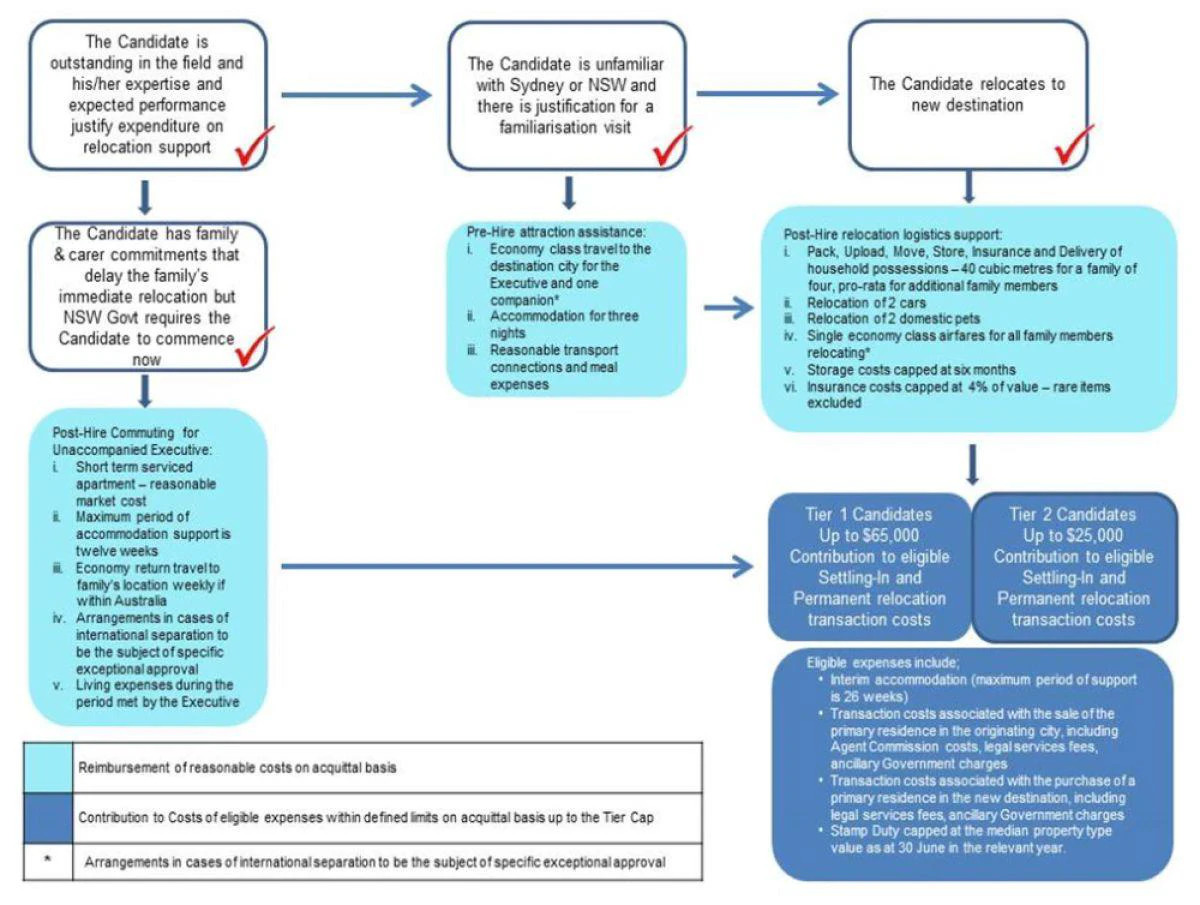
Senior Executive Relocation Expenses (NSW Government Framework)
A relocation expenses package is only available where:
- The employer of the executive has determined that the candidate is ‘outstanding’ in that they are the best candidate in the recruitment field and their expertise/experience justify the relocation support, and
- The executive is to be employed in the government sector in a location other than where they currently reside and it would be unreasonable without support to require the executive to relocate.
The applicable cap in relation to post hire relocation support is up to $65,000 for Tier 1 executives (Heads of executive agencies determined by the Secretary). See below for details.
The closing date for applications is Wednesday, 22 July 2026
The reference number to include in your application is H26_5528.
Note: Please use the online platform to submit your application. It will not be accepted via email.
If you require assistance in submitting your application online, please get in touch with Executive Search Coordinator, Sarah Prebble: M: +61 (0)430 219 787 / E: sprebble@hardygroupintl.com
Your application must include:
- Cover letter addressed to the Principal Consultant;
- A written response addressing the key selection criteria; and
- An up to date copy of your Curriculum Vitae.
It Is standard practice for HardyGroup to acknowledge receipt of your application no later than the next business day. We request that if you do not receive the acknowledgement, you contact the search coordinator listed above as soon as possible after the 24-hour business period and arrange to resend your application if necessary.
For a confidential discussion, please contact:

Paul Ingle
HardyGroup Chief Executive Officer
M. +61 (0)402 796 125
E. pingle@hardygroupintl.com

Pete Carter
HG Principal Consultant
M. +61 (0)448 729 077 | M. +64 (0)27 287 5937
E. pcarter@hardygroupintl.com
ABOUT US
HardyGroup’s (HG) mission is simple
Find and Grow Great Leaders - and we have been doing exactly that for more than 30 years in public and private health, primary, community and aged care as well as the broader public service.
Our synergistic business model of Executive Search and Recruitment integrated with Executive Leadership and Learning is our unique point of difference.
It ensures our clients can count on us for the lifecycle of their organisations leadership journey and why we are regarded as the leading trans-Tasman partner agency by clients.
When engaging HG you can be confident in a deeply personalised experience and service as nothing matters more to us than relationships and results.