
Head of School, Health Equity
and Innovation
The University of Waikato |
Te Whare Wānanga o Waikato

CANDIDATE INFORMATION PACK
Scroll down to access everything you need.

Executive Summary
- Lead one of Aotearoa’s most future-focused health portfolios, shaping education, research and workforce innovation that directly influences health outcomes for communities.
- Drive meaningful equity-led change by embedding Te Tiriti o Waitangi, cultural safety and community partnership at the core of academic leadership and programme design.
- Influence nationally and collaborate locally, working alongside iwi, Pacific communities, Te Whatu Ora and sector leaders to deliver real-world impact.
The Opportunity
This is a rare opportunity to shape one of Aotearoa’s most strategically significant health portfolios at a pivotal time for health equity, workforce reform, and community-led innovation.
The University of Waikato’s Division of Health has an explicit mandate to address health inequities and preventable conditions, with a strong focus on Māori and Pacific communities. Within that context, the School of Health Equity and Innovation plays a critical leadership role across teaching, research and sector partnership, acting as both an academic centre of excellence and a systems-change agent within the health system.
As Head of School, you will be entrusted with a mandate to build a culturally grounded, future-focused School that advances equity through curriculum, research, professional education and partnership. You will lead a portfolio that includes undergraduate programmes such as the Bachelor of Health and Health Promotion, an expanded taught postgraduate suite including Master’s level study, and a growing portfolio of workforce development and professional education offerings beyond traditional degree pathways.
The role offers the scale, influence and authority to shape education, policy and practice nationally and to position the University as a leading provider of equity-led health programmes and professional development across Te Manawa Taki and beyond.
The Role
Reporting to the Pro Vice-Chancellor (Health), you are a senior member of the Division of Health Leadership Team, providing academic, strategic and operational leadership across a broad and evolving portfolio.
You will:
- Lead the strategic development of the School, ensuring alignment with Te Tiriti o Waitangi, University priorities, and national health reform.
- Drive curriculum innovation across undergraduate, postgraduate and professional education, including the development of an expanded taught postgraduate portfolio with a Master of Public Health (or equivalent) as a flagship offering.
- Establish and grow professional education, micro-credentials and alternative learning pathways to support workforce development.
- Lead research strategy, capability and funding development with a strong emphasis on equity-centred, community-engaged and translational research.
- Actively build and steward partnerships with iwi, Pacific communities, Te Whatu Ora, government agencies and innovation networks.
- Provide financial leadership and contribute to sustainable growth through external income and strategic investment.
- Foster a high-performing culture grounded in cultural safety, inclusion, integrity and innovation.
You will also play a critical role unifying equity and innovation activity across the Division of Health, supporting interdisciplinary teaching, research and collaboration across professional schools.
The Candidate
You will be an academic leader of standing, typically at Associate Professor or Professor level, with a strong reputation in health research, leadership and education.
You will bring:
- Deep understanding and practical leadership in Te Tiriti-led, equity-centred education and research.
- Credibility with Māori and Pacific communities and across the health sector.
- A proven track record in building programmes, growing research capability and leading people.
- Strategic and commercial acumen to develop new offerings and partnerships.
- A collaborative, inclusive and courageous leadership style.
Above all, you will be a values-driven leader motivated by impact: improving health outcomes, shaping workforce capability, and building an academic environment where people and communities thrive.
We invite you to discuss this exceptional leadership opportunity with David Price from the HardyGroup
M. +64 (0)21 0239 2211 | E. dprice@hardygroupintl.com or Lynette Taylor M. +61 (0)431 293 861 |
E. ltaylor@hardygroupintl.com or Paul Ingle M. +61 (0)402 796 125 E. pingle@hardygroupintl.com

The University of Waikato
Our story
The University began with just over 100 students in 1964, and celebrated its first 20 graduates of the Bachelor of Arts in 1967. We have grown a lot since then, and now have more than 13,000 students annually from all over New Zealand and the world.
The University of Waikato opened in 1964 after many years of energetic lobbying by a group of Hamilton locals, determined to have a university in their city. To begin with, facilities were sparse, but in early 1965 new buildings were officially opened by then Governor-General Sir Bernard Fergusson. Sir Don Llewellyn was the founding Vice-Chancellor.
By the 1980s, Waikato was the fastest-growing university in New Zealand. Computer Science became an increasingly popular study choice and the thriving Department was elevated to a School of Computing and Mathematical Sciences in 1987.
The University always had a close relationship with its neighbouring teachers’ college and, leading the way for others to follow, became the first university in New Zealand to combine with its regional teachers’ college. Through its teaching programmes, the University began to establish a presence in Tauranga.
Our vision
Ko te tangata | For the people
A research-intensive university providing a globally connected, innovative and inclusive student experience in an environment characterised by a commitment to diversity, respect for Indigenous knowledge, and high levels of community engagement.
Our values
Ko te mana o Te Whare Wānanga o Waikato ka herea ki tō tātou:
- Tu ngātahi me te Māori
- Mahi pono
- Whakanui i ngā huarahi hou
- Whakarewa i te hiringa i te mahara
The University of Waikato places a high value on:
- Partnership with Māori
- Acting with integrity
- Celebrating diversity
- Promoting creativity
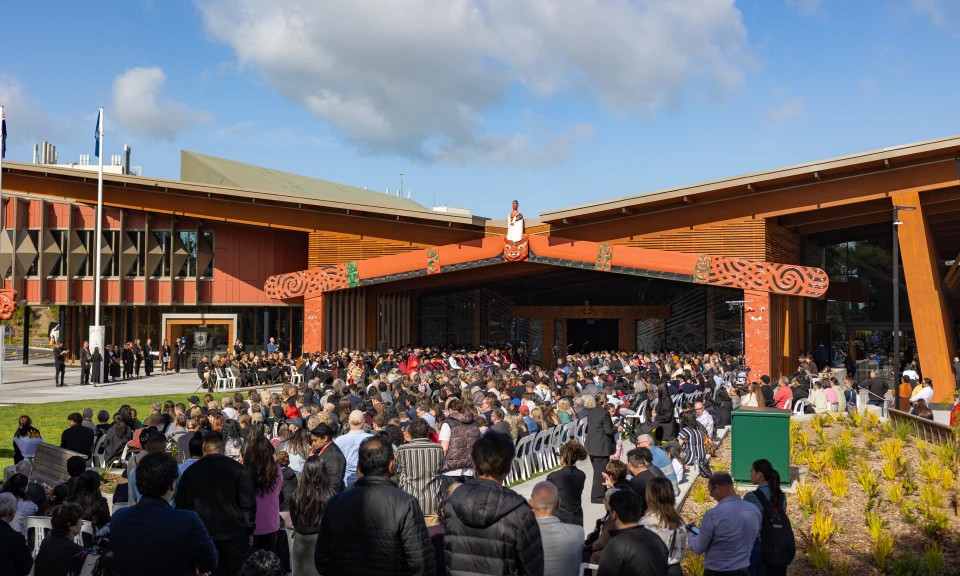
Strategic Priority
A key strategic priority for the Division and University is the establishment of the New Zealand Graduate School of Medicine (NZGSM), which will welcome its first cohort of students in 2028. This new medical school will embody the University’s motto, Ko Te Tangata – For the People, with a focus on advancing health equity through culturally responsive medical education, particularly in regional and rural communities.
The NZGSM will distinguish itself through genuine and close partnerships with health service providers. Its teaching and research will reflect national workforce needs and the aspirations of regional and rural communities. A high proportion of its graduates are expected to pursue careers in primary care, and all graduates will be recognised for working effectively in multidisciplinary teams.
Role Specification
The Head of School of Health Equity and Innovation will provide academic, strategic, and operational leadership to a School focused on advancing health equity and driving innovation in health education, research, and community engagement. The role is pivotal in cultivating an inclusive, transdisciplinary environment that responds to regional, national, and global health priorities, with a strong focus on Te Tiriti o Waitangi obligations and Māori and Pacific worldviews of health.
The Head of School will oversee the delivery and continuous improvement of existing offerings and lead the development of an expanded suite of taught postgraduate programmes, including a Master of Public Health (or equivalent). The Head of School will also establish opportunities for professional development beyond traditional credit-bearing study, enabling health professionals to upskill through flexible learning pathways.
As a member of the Division of Health Senior Leadership Team, the Head of School will work closely with the Pro Vice-Chancellor, other Heads of Schools and Programmes, and Associate Deans. They will foster a collaborative, inclusive environment that encourages excellence in teaching, research, and service, with a shared commitment to addressing inequities in health outcomes.
Provide academic and business leadership within the School of Health Equity and Innovation:
- Ensure alignment with regulatory, policy, and strategic frameworks, including the expectations of Te Tiriti o Waitangi, the University Strategy, and health sector reform priorities.
- Lead the development, implementation, and continuous review of academic programmes that are culturally grounded, future-focused, and responsive to the priorities of Māori, Pacific, and underserved communities.
- Foster strong working relationships with key health sector partners, including Te Whatu Ora, Māori and Pacific health providers, and innovation networks, to support student placements, research collaboration, and system transformation.
- Co-design programmes and research initiatives with Māori, Pacific, and underserved communities to ensure teaching and scholarship reflect the needs, values, and aspirations of those most impacted by health inequities.
- Provide visionary academic leadership that fosters a culture of equity, innovation, and excellence in teaching, research, and engagement.
- Provide academic oversight and leadership for the Health Promotion and Healthy Active Living undergraduate majors, as well as postgraduate papers within the Master of Health Science, ensuring they remain relevant, evidence-based, and equity-led.
- Strengthen and expand undergraduate pathways that support progression into clinical, postgraduate, and professional health programmes, particularly in areas of identified workforce need.
- Guide curriculum innovation to ensure programmes embed equity, cultural safety, and interdisciplinary approaches that prepare graduates to lead in complex health systems.
- Create an inclusive and high-performing academic environment that supports the wellbeing, capability, and career development of staff and students.
- Develop and monitor the School’s operational plan, ensuring alignment with the Division of Health Strategic Plan, Business Plan (2026–28), and University priorities.
- Lead the development of a School-wide research strategy that enhances equity-centred research capability, strengthens community-led and transdisciplinary research partnerships, and increases research impact and funding success.Contribute to the financial sustainability of the School by ensuring efficient use of resources, supporting external income generation, and aligning activities with performance expectations.
Strengthen partnerships with iwi, community-led, and Pacific health organisations to ensure the School’s programmes and research are grounded in regional and national health priorities.
Manage staff within the School of Health Equity and Innovation:
- Implement and maintain Human Resource strategies and policies.
- Plan for the most suitable workforce and manage appropriate staffing levels.
- Implement performance management and professional development, including coaching and feedback, to develop staff.
Manage finances and resources, including preparing and monitoring the School of Health Equity and Innovation budget and planning and managing physical resources.
Lead the development, planning, and delivery of high-quality postgraduate programmes and other workforce development opportunities, including expanding the School’s portfolio to meet emerging sector needs and support academic and professional pathways in health equity and innovation.
Develop and maintain networks and relationships within and external to the University that enhance the Division’s ability to foster innovation and deliver interdisciplinary, equity-led teaching and research that responds to evolving sector needs.
Develop opportunities and initiatives that support the Division’s and University’s strategy, including contributing to the Divisional Leadership Team and acting as a key advisor to the Pro Vice-Chancellor.
Undertake teaching and research at an appropriate level.
Participate in maintaining a safe and healthy work environment for self and others including students. Comply with and undertake responsibilities set out in the University’s Health and Safety Policy. Undertake line manager health and safety responsibilities as set out in the University’s Health and Safety Policy.
Any other duties as required that are consistent with the position held and work in the best interests of the Division and University (including its community of students and staff), within relevant legislation and in accordance with the University Charter.
NOTE: The Head of School of Health Equity and Innovation will have an annual Objectives, Development and Reflection (ODR) meeting with the Pro Vice-Chancellor. New appointees will normally attend such a meeting approximately three months after taking up the role.
1. Academic Standing and Scholarly Leadership
A PhD or equivalent in a health-related discipline, with appointment at, or readiness for appointment to, Associate Professor or Professor level. Demonstrated record of research excellence, academic leadership, and contribution to scholarly advancement in health or a related field.
2. Commitment to Health Equity and Te Tiriti-Led Practice
Demonstrated understanding and application of Te Tiriti o Waitangi within academic leadership, education and research. A genuine commitment to health equity, cultural safety and kaupapa Māori-informed practice, with experience working alongside Māori, Pacific and underserved communities.
3. Strategic Leadership and School Development
Proven capability to lead at a senior academic level, including setting strategic direction, growing capability, managing complex portfolios and building organisational culture. Experience establishing or scaling programmes, initiatives or research centres is highly desirable.
4. Education Innovation and Workforce Impact
Track record in curriculum design and education leadership, including development of undergraduate, postgraduate or alternative learning models. Demonstrated capacity to innovate in workforce development and health education to address real-world challenges and sector need.
5. Research Leadership and External Partnerships
Evidence of leading research programmes, building collaborative research cultures and securing external funding. Experience developing partnerships with communities, government agencies, iwi, health providers and industry to create meaningful impact beyond the University.
6. Commercial Acumen and Programme Development
Demonstrated ability to identify and develop commercial opportunities, including non-credit programmes, micro-credentials, executive education, or industry-linked initiatives. Financial and strategic acumen to grow sustainable, high-value partnerships and programmes.
7. People Leadership and Cultural Stewardship
A collaborative and enabling leadership style, with proven experience leading diverse academic teams. Able to build high-performing cultures that support staff and students to thrive, underpinned by inclusive practice, integrity and authenticity.
Essential
● A PhD or equivalent qualification in a health-related field (e.g. public health, health sciences, health equity, Māori and Pacific health, health innovation)
Preferred
- Current appointment at the Associate Professor or Professor level
PERSONAL QUALITIES
- A strong commitment to equal opportunity, anti-racism, and to the University’s strategic partnership with Māori as articulated through Te Tiriti o Waitangi
- Self-motivated and proactive, with a commitment to innovation, equity, and continuous improvement
- Demonstrated capacity to lead through influence, collaboration, and culturally grounded practice
- Resilient, adaptable, and solutions-focused under pressure
- Able to work effectively and respectfully with students and staff from diverse backgrounds, with cultural competence and humility
- Committed to creating a positive, inclusive academic culture based on openness, collegiality, and wellbeing
Reports to: Pro Vice-Chancellor of Health
Internal:
- Pro Vice-Chancellor of Health
- Associate Deans
- Heads of Schools and Programmes within the Division
- Director, Division of Health
- Division Managers
- The Vice-Chancellor and Deputy Vice-Chancellors
- Assistant Vice-Chancellor Pacific
- Staff from the Office of the DVC Māori
- Directors of Research Institutes and Centres
- Other academic and professional staff in the Division and the University.
External:
- Māori and Pacific health provider organisations
- Health New Zealand | Te Whatu Ora (regional and national)
- Community and iwi partners involved in health equity initiatives
- Professional and regulatory bodies across health disciplines
- Innovation and public health networks
- Ministry of Health and other government agencies
- Research funding bodies (e.g. HRC, MBIE)
- NGOs, primary care networks, and local health alliances
- International academic and research partners
- External clients and organisations, contractors and suppliers
- Other external stakeholders
Please discuss with Hardygroup Consultant
Service Location: Hamilton, New Zealand
Division: Division of Health
Tenure: Three Years
The closing date for applications is Tuesday, 20th January 2026
The reference number to include in your application is H25_5333
Note: Please use the online platform to submit your application. It will not be accepted via email.
If you require assistance in submitting your application online, please get in touch with Executive Search Coordinator, Aldie Zuñiga: M: +61 (0)49 410 1082 / E: azuniga@hardygroupintl.com
Your application must include:
- 1.Cover letter addressed to the Principal Consultant;
- 2.A written response addressing the key selection criteria; and
- 3.An up to date copy of your Curriculum Vitae.
It Is standard practice for HardyGroup to acknowledge receipt of your application no later than the next business day. We request that if you do not receive the acknowledgement, you contact the search coordinator listed above as soon as possible after the 24-hour business period and arrange to resend your application if necessary.
For a confidential discussion, please contact:

David Price
National Manager, HardyGroup New Zealand
M. +64 (0)21 0239 2211
E. dprice@hardygroupintl.com

Lynette Taylor
Executive Director - Search & Recruitment, HardyGroup Australia & New Zealand
M. +61 (0)431 293 861
E. ltaylor@hardygroupintl.com

Paul Ingle
Chief Executive Officer, HardyGroup Australia & New Zealand
M. +61 (0)402 796 125
E. pingle@hardygroupintl.com
Living and Working
in Hamilton, Waikato
Living and Working in Waikato
Waikato, New Zealand, offers a blend of rural and urban lifestyles with key economic drivers in agriculture, dairy, and manufacturing. The region is known for its fertile land and is a hub for agricultural research and innovation, with opportunities in related sectors. It also has a major urban center in Hamilton, which provides various services, a university, and diverse job prospects.
Waikato
The Waikato region is located on New Zealand’s North Island, stretching from the Coromandel through Lake Taupo in the centre, heading on down to King Country in the Island’s southern half. Just under half a million people live in the area, with Hamilton the main centre – a city of innovation and technology, giving it the nickname ‘Hamiltron’.


Hamilton
Discover the vibrant city of Hamilton and its thriving workforce. Experience top-notch dining, a buzzing nightlife and an active outdoor lifestyle. Find where to live and work in Hamilton and enjoy the perfect work-life balance. With a range of job opportunities to choose from, there is something for everyone.
Hamilton Population and Demographics
Situated on the banks of the Waikato River, Hamilton is New Zealand’s largest inland city. It’s currently one of the fastest growing urban areas in the country. The population of Hamilton is youthful and innovative – around half of its residents are under the age of 30. It’s also a very culturally diverse city, home to more than 80 ethnic groups.
Hamilton Weather and Climate
Hamilton’s climate is generally mild, warm and temperate. The average temperature in summer is 21C and 14C in winter. On average, the warmest month is February and the coolest month is July. There is a significant amount annual rainfall in Hamilton, which helps keep the city green.
Hamilton Entertainment & Things to Do
There is a wide array of things to do in Hamilton and the Waikato region. The city centre is packed with restaurants, cafes, bars and casinos where you can have a fun night out. The vibrant nightlife scene is a draw for many travellers and migrants – and on the weekends, you’ll find various markets selling gourmet food and locally-crafted artwork and goods. The city also hosts events like sports matches, concerts, festivals and comedy shows that attract hundreds of locals and visitors every year.

Hamilton is also well known for its stunning parks and gardens. The Hamilton Gardens is the most popular attraction in the Waikato region. This award-winning attraction is well-loved by tourists and locals alike. The Garden takes you on a journey through a gallery of local and international species, with beautifully-manicured examples of traditional gardens from Japan, Italy, China, and much more that each tell their own unique story. Other fun places to spend time include the Hamilton Zoo, the Waikato Museum and Water World.
Hamilton also has close proximity to other regional destinations. Tourist hotspots like Auckland and Rotorua are within a couple hours’ drive from the city – so on your weekend breaks, you can venture out of Hamilton and explore more of the central North Island.
For more information on Living in Hamilton visit.
ABOUT US
HardyGroup’s (HG) mission is simple
Find and Grow Great Leaders - and we have been doing exactly that for more than 30 years in public and private health, primary, community and aged care as well as the broader public service.
Our synergistic business model of Executive Search and Recruitment integrated with Executive Leadership and Learning is our unique point of difference.
It ensures our clients can count on us for the lifecycle of their organisations leadership journey and why we are regarded as the leading trans-Tasman partner agency by clients.
When engaging HG you can be confident in a deeply personalised experience and service as nothing matters more to us than relationships and results.